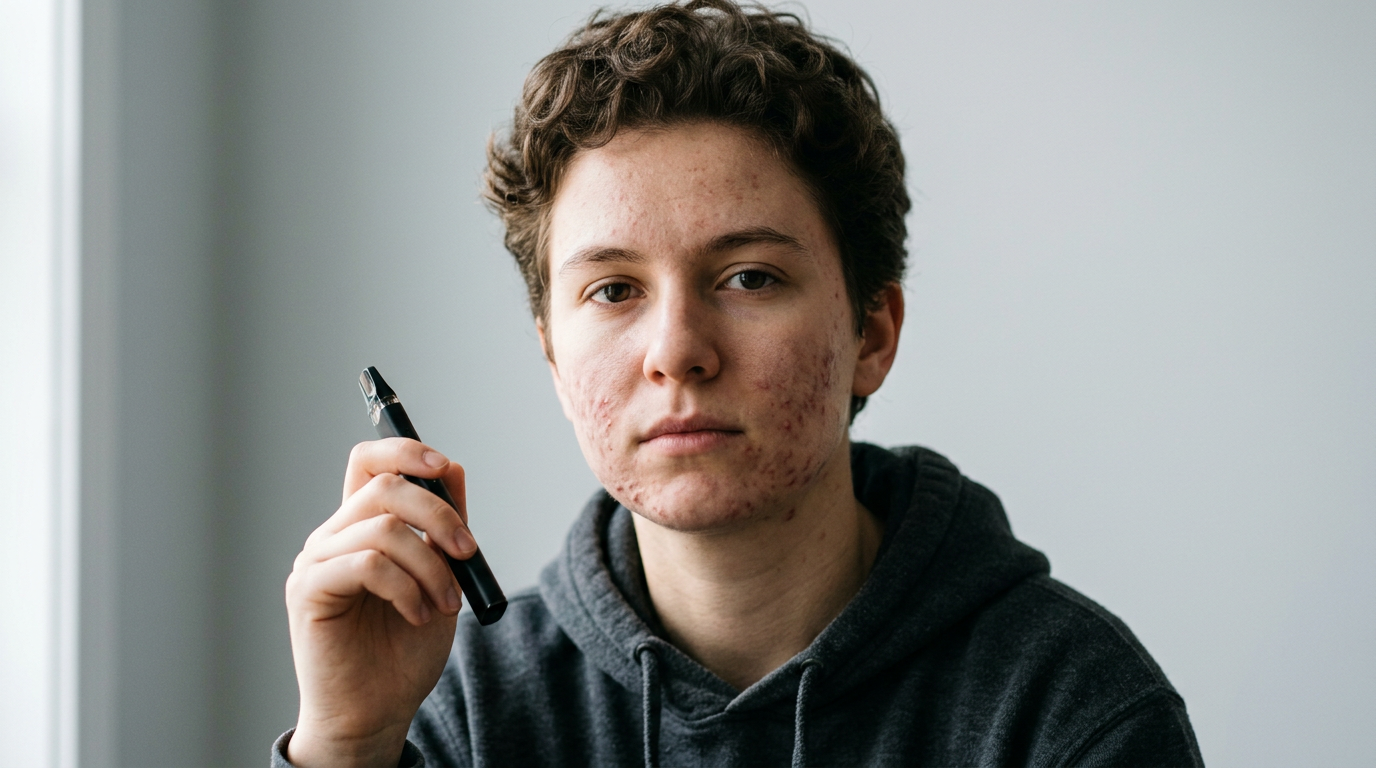
You switched to vaping thinking it was safer. Maybe you never smoked at all — just picked up a vape because everyone else did. But now your skin is breaking out like crazy. Your face is covered in bumps that won’t go away.
Is vaping the reason?
The short answer: yes, vaping can cause acne. And it’s probably making your existing breakouts worse.
Here’s what’s actually happening to your skin — and what you can do about it.
What Happens to Your Skin When You Vape
Every time you vape, chemicals enter your bloodstream. They travel through your body and affect your skin from the inside.
Think of it this way. Your skin is like a garden. It needs water, oxygen, and nutrients to stay healthy. Vaping cuts off all three.
Here’s how:
Your blood vessels shrink.
Nicotine makes the tiny blood vessels in your skin get smaller. This means less oxygen reaches your skin cells. Without oxygen, your skin can’t repair itself properly. Old, damaged cells stick around longer than they should.
Your skin dries out.
Most vape juice contains something called propylene glycol. It pulls moisture out of your body. Your skin loses water from the inside. Dry skin produces more oil to compensate. More oil means clogged pores. Clogged pores mean acne.
Heat damages your pores.
The vapor itself is hot. When it touches your face (and it does, constantly), it irritates your pores. Irritated pores get inflamed. Inflamed pores turn into pimples.
Free radicals attack your cells.
Vaping creates oxidative stress in your body. This is a fancy way of saying it releases unstable molecules that damage healthy cells. Your skin cells are constantly under attack. Damaged skin cells can’t fight off acne-causing bacteria as well.
Studies show that nicotine can reduce collagen production by up to 40%. Collagen is what keeps your skin firm and helps it heal. Less collagen means slower healing. That pimple that should disappear in a few days? It sticks around for weeks instead.
The Link Between Nicotine and Acne Breakouts
Most people think nicotine only affects the lungs. Wrong.
Your skin has nicotine receptors too. When nicotine hits these receptors, things start going wrong.
Your hormones go haywire.
Nicotine increases androgen hormones in your body. Androgens tell your oil glands to make more sebum (skin oil). More sebum equals more clogged pores. More clogged pores equal more acne. It’s a simple chain reaction.
Your stress hormones spike.
Nicotine triggers cortisol release. Cortisol is your body’s stress hormone. High cortisol levels are directly linked to acne breakouts. This is why you get pimples before big tests or stressful events. Vaping creates that same stress response — constantly.
Your skin can’t heal.
Nicotine slows down wound healing. A lot. Research shows nicotine users are up to 3 times more likely to report skin problems. When you pop a pimple or scratch your face, it takes longer to heal. Bacteria has more time to get in. Infections happen more easily.
The oil keeps coming.
Your sebaceous glands (oil-producing glands) go into overdrive when exposed to nicotine. They pump out more oil than your pores can handle. The oil mixes with dead skin cells. The mixture clogs your pores. Bacteria feeds on the trapped oil. You get inflamed, painful acne.
Here’s how to tell if nicotine is causing your acne:
- Breakouts got worse after you started vaping
- Pimples are inflamed and cystic (deep, painful bumps)
- They appear mostly on your cheeks, chin, and jawline
- They take forever to heal
- Your skin feels oily but also dehydrated
If this sounds like you, nicotine is probably the culprit.
Vape Ingredients That May Be Wrecking Your Skin
You know what’s actually in your vape juice? If you think it’s just water vapor and flavor, you’re very wrong.
The CDC says vape aerosol contains over 2,000 chemicals. Many of them are bad for your skin.
Propylene Glycol – Danger Level: High
This ingredient is in almost every vape juice. It creates the “vapor” you see. But it also sucks moisture out of everything it touches. When you vape, propylene glycol dehydrates you from the inside. Your skin loses water. It compensates by making more oil. The cycle of clogged pores begins.
You’ll notice your skin feels tight and dry, but you’re also breaking out. That’s the propylene glycol effect.
Vegetable Glycerin – Danger Level: Medium
This makes vape clouds thick and puffy. It’s not as drying as propylene glycol, but it has another problem. When vapor settles on your skin (and it does, all over your face), the vegetable glycerin residue can clog your pores directly. It’s sticky and thick. Your pores trap it along with dirt and oil.
Artificial Flavoring Chemicals – Danger Level: High
That strawberry or mango flavor? It comes from chemicals. Lots of them. Some flavoring compounds are known skin irritants. Others cause inflammation when they enter your bloodstream. Inflammation triggers acne.
The sweet and fruity flavors tend to have more chemicals than tobacco or menthol flavors. More chemicals mean more potential for skin damage.
Formaldehyde and Acrolein – Danger Level: Very High
These aren’t ingredients — they’re byproducts created when vape juice is heated. Both are toxic. Both cause inflammation. A Johns Hopkins study found formaldehyde in almost every vape product tested. Your skin reacts to these toxins with redness, irritation, and breakouts.
Heavy Metals – Danger Level: Very High
The metal coil that heats your vape juice? Tiny particles of nickel, tin, and lead break off. You inhale them. They enter your bloodstream. Your body tries to get rid of these metals through your skin (among other organs). This process causes inflammation and can trigger severe acne.
The longer you use the same vape device, the more degraded the coil gets. More degradation means more heavy metal exposure.
Does Vaping Cause More Acne Than Smoking?
Both smoking and vaping are terrible for your skin. But they damage it in different ways.
Smoking reduces blood flow more severely than vaping. Smokers get “smoker’s face” — wrinkled, gray, sagging skin. They tend to get more blackheads and whiteheads. The skin looks dull and ages faster.
Vaping causes more chemical-driven inflammation. Vapers tend to get angrier, more inflamed acne. Think deep, painful cystic bumps instead of small blackheads. The breakouts are often worse and harder to treat.
Here’s the problem: vaping is too new for long-term studies. Cigarettes have been studied for decades. We know exactly what they do to skin over 20 or 30 years. Vaping has only been popular since around 2015. We’re just starting to see the skin damage.
Some dermatologists are seeing what they’re calling “vaper’s face” in their young patients. Dehydrated skin with severe inflammatory acne. Premature fine lines around the mouth. Dull, uneven skin tone.
Neither smoking nor vaping is “better” for your skin. Both will mess it up. If you vape thinking it’s safer than smoking — it might be for your lungs, but your skin is still taking a hit.
What Dermatologists Say About Vaping and Skin Health
Board-certified dermatologists are getting concerned. They’re seeing more patients — especially teenagers — with severe acne that started after vaping.
Dr. Whitney Bowe, a well-known dermatologist, explains that nicotine affects skin in ways most people don’t realize. It doesn’t just restrict blood flow. It actually changes how your skin functions at the cellular level. The damage happens deep in the skin layers before you see it on the surface.
The American Academy of Dermatology has started warning about vaping and skin health. They note that many teens who vape develop acne worse than their non-vaping friends. The pattern is becoming clear in clinical settings.
Here’s what dermatologists are observing in vaping patients:
- Acne that doesn’t respond well to normal treatments
- Severe dehydration even when drinking plenty of water
- Skin that looks older than it should for the patient’s age
- Delayed healing from acne scars and marks
- Increased sensitivity and redness
The good news? Doctors report that skin can start recovering when people quit vaping. Sometimes within just 4 to 6 weeks, patients notice improvements. Breakouts get less severe. Healing speeds up. The skin starts looking healthier.
Try the 30-Day Skin Test:
Dermatologists suggest this experiment if you’re not sure vaping is causing your acne:
- Week 1: Take clear photos of your skin. Document your current breakouts.
- Week 2: Cut your vaping in half. Note any changes.
- Week 3: Stop vaping completely if you can.
- Week 4: Take new photos. Compare them to Week 1.
If your skin looks better, you have your answer. If it looks the same or worse, something else might be causing your acne. Either way, you’ll know.
How to Clear Acne If You Vape
Let’s be real. Quitting is hard. Maybe you’re not ready yet. Maybe you’re trying but struggling.
Here’s how to give your skin a fighting chance while you figure it out.
Morning Routine:
Start with a gentle cleanser. Don’t use harsh scrubs or strong soaps. Your skin is already irritated from vaping. Harsh products make it worse. Look for something labeled “gentle” or “for sensitive skin.”
Use a niacinamide serum next. Niacinamide reduces inflammation and controls oil production. Both things your skin desperately needs if you vape. A few drops is enough. Pat it into your skin.
Follow with an oil-free moisturizer. Yes, even if your skin is oily. Remember, vaping dehydrates you. Your skin makes excess oil to compensate. Adding the right moisturizer tells your skin it doesn’t need to overproduce oil.
Finish with SPF 30 or higher. Nicotine makes your skin more sensitive to sun damage. You’re more likely to get sun spots, dark marks, and premature aging. Sunscreen is non-negotiable. If you notice new breakouts after starting sunscreen, you might be experiencing an allergic reaction to sunscreen rather than worsening acne from vaping.
Night Routine:
Double cleanse. First, use micellar water on a cotton pad. Wipe your entire face. This removes the day’s buildup — including vape residue that settled on your skin. Second, use a foaming cleanser to actually clean your pores.
Apply a salicylic acid toner. Salicylic acid gets deep into pores and unclogs them. It’s one of the best ingredients for acne. Use it every night if your skin can handle it, or every other night if you’re sensitive.
Use a retinol product. Retinol repairs damaged skin cells and speeds up cell turnover. This is crucial because nicotine slows down your skin’s natural repair process. Retinol helps counteract that. Start slow — maybe twice a week — and build up.
End with a thick moisturizer. Your skin needs to repair itself overnight. Heavy-duty hydration helps.
Other Important Steps:
Drink more water than you think you need. Vaping dehydrates you. You need to overcompensate. Aim for at least 8 glasses a day. More if you can.
Wash your pillowcase twice a week. Vape residue settles on it. Then your face sits on it for 8 hours. You’re basically rubbing your face in the stuff that’s causing breakouts.
Don’t touch your face. Your hands carry bacteria and more vape residue. Every time you touch your face, you’re transferring it to your pores.
Change your diet if needed. Cut back on dairy and high-sugar foods. Both can make acne worse, especially when your skin is already struggling.
When to See a Dermatologist:
Go see a professional if:
- Your acne is painful or cystic
- Over-the-counter products aren’t helping after 8 weeks
- You’re getting acne scars
- Your skin is affecting your mental health
A dermatologist can prescribe stronger treatments. They might suggest topical antibiotics, prescription retinoids, or even oral medications if your acne is severe enough.
But here’s the truth: all these tips will help manage your acne. They won’t fix the root cause if vaping is the problem. The most powerful thing you can do is quit.
The Bottom Line
So does vaping cause acne? Yes. The science is clear on this.
Nicotine messes with your hormones and oil production. It cuts off oxygen to your skin. It slows healing. The chemicals in vape juice dehydrate you, clog your pores, and cause inflammation. The heat irritates your skin. The heavy metals poison your cells.
Your skin is paying the price every time you vape.
If your acne started or got worse when you started vaping, that’s not a coincidence. Your body is telling you something.
The good news is that your skin can recover. It might take weeks or months, but it can heal. Younger people especially can see dramatic improvements once they stop vaping.
You have options. You can try cutting back gradually. Or you can talk to your doctor about nicotine replacement that doesn’t involve vaping. You can work with a dermatologist to manage your skin while you quit.
But the fastest way to clear skin? Stop putting nicotine and chemicals into your body.
Your skin — and the rest of your body — will thank you for it.
If you’re dealing with vaping-related acne right now, start with small steps. Try the 30-day test. Clean up your skincare routine. Drink more water. Take photos to track your progress.
And when you’re ready, talk to a doctor. About both the vaping and the acne. You don’t have to figure this out alone.
Your skin is trying to tell you something. It’s time to listen.